

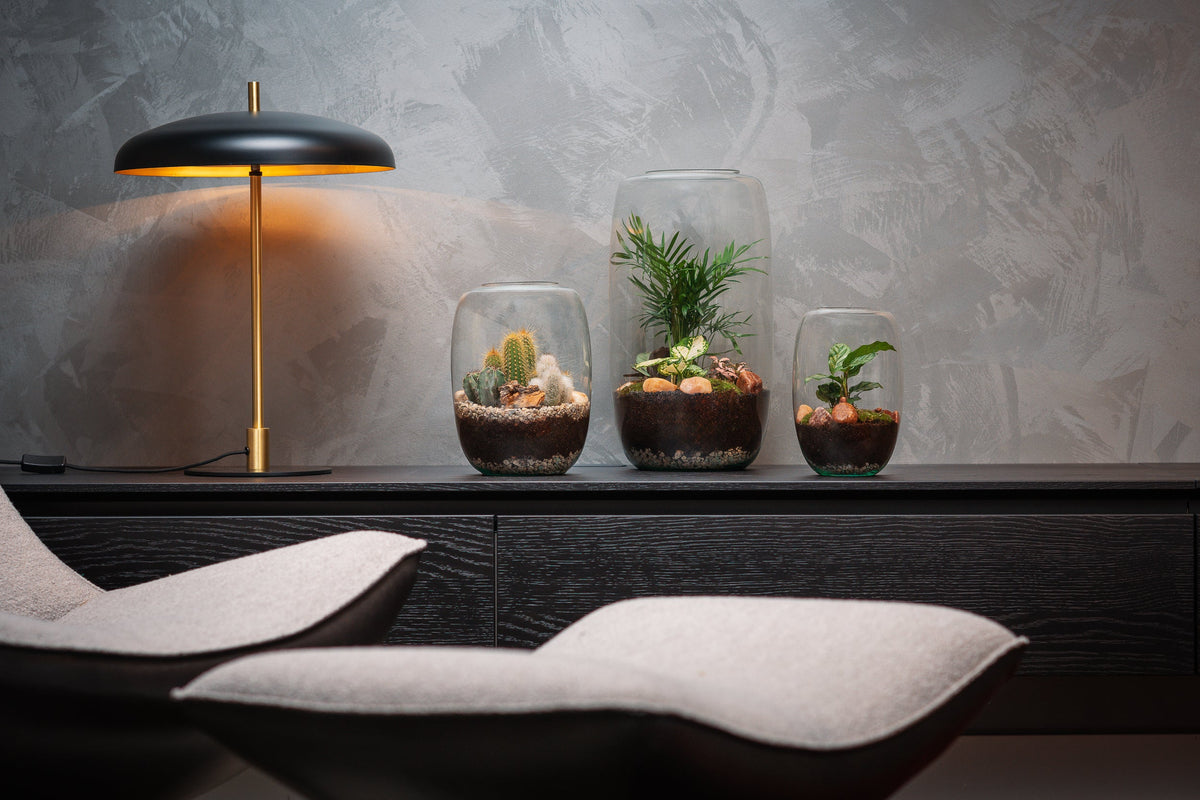
An urban jungle is a living style where houseplants take center stage. With plenty of greenery, natural materials, and plants at various heights, you can turn your home into a tranquil and vibrant jungle. In this guide, you will learn exactly what an urban jungle is, which plants work best in which light, how to build it step by step, and how an urban jungle terrarium allows you to create a green oasis even without a green thumb.
What is an urban jungle?
Urban jungle literally means "city jungle." It is an interior style where you fill your home with houseplants to create a green, natural atmosphere indoors. The urban jungle style emerged because many city homes lacked a jungle vibe. In this style, plants are not just individual decorations, but the most important part of the interior.
You can recognize an urban jungle by:
- Many plants in different sizes: from a large statement plant on the floor to small plants on a shelf.
- Greenery at multiple heights: on the floor, on tables, hanging from the ceiling, and against the wall.
- Natural materials: wood, rattan, linen, terracotta, and glass.
- A calm color palette: earth tones and green, allowing the plants to stand out.
The interior style became popular in recent years and has since grown into an enduring way of living. More and more people want peace, nature, and a healthy indoor climate at home, and an urban jungle combines all of that.

Why choose an urban jungle at home?
More peace and ambiance: A green oasis in your home instantly gives a room a softer, calmer appearance. Many people find a house full of plants to be relaxing.
A living interior: Plants grow, produce new leaves, and change with the seasons. As a result, your interior never feels finished or boring.
Better humidity: Plants release water through their leaves. In a room with many plants, the air becomes slightly more humid, which is pleasant in a dry, heated house.
Air-purifying, but in moderation: Plants absorb small amounts of substances from the air. In an ordinary living room, this effect is small; good ventilation remains more important. The real benefit of an urban jungle lies in its atmosphere and well-being.
Creating an urban jungle in 7 steps
1. Look at the light first
Light determines which plants will grow in your home. Walk through your house and look at how much daylight enters each spot: direct sunlight near a south-facing window, bright indirect light a few meters from the window, or low light in a corner or hallway. Only then should you choose your plants.
2. Start with a strong base
Begin with three to five easy plants that can take a beating, such as a Sansevieria, ZZ plant, or Scindapsus. This helps you learn how plants behave in your home. If that goes well, you can expand with plants that require more attention.
3. Choose a statement plant
A large plant, such as a Monstera, Strelitzia, or Ficus, serves as the centerpiece of your urban jungle. Place it in a bright spot where it has space, for example next to the sofa or in an empty corner.
4. Work in layers and at different heights
The jungle atmosphere is created when greenery is at multiple levels. Combine floor plants with plants on a side table, a plant stand, a windowsill, or a wall shelf. Small plants look larger when placed on a raised surface.
5. Use hanging and climbing plants
Hanging plants such as Scindapsus, Philodendron scandens, or Rhipsalis fill space without taking up floor area. Hang them from the ceiling, place them on top of a cabinet, or let them grow down along a shelf.
6. Group plants together
Plants in a group of three or five look fuller than individual plants scattered throughout the room. A group also keeps the humidity around the plants slightly higher.
7. Expand slowly
An urban jungle grows along with you. Add a plant every few months, take cuttings from plants that are doing well, and swap with friends. This creates a personal jungle with plants that truly fit your home.
The best urban jungle plants by lighting situation
Choose plants that match the light in the spot where they will be placed.
| Lighting situation | Suitable plants | Care |
|---|---|---|
| Lots of light, including direct sunlight | Strelitzia, Ficus lyrata, cacti, succulents, Yucca | little water, lots of light |
| Bright indirect light | Monstera, Pilea, Calathea, Anthurium, Philodendron, Alocasia | keep soil slightly moist |
| Partial shade | Scindapsus, Fittonia, fern, Peperomia, Spathiphyllum | regular water, higher humidity |
| Low light | ZZ plant, Sansevieria, Aspidistra, Scindapsus | little water, very hardy |
Easy urban jungle plants for beginners: ZZ plant, Sansevieria, Scindapsus, Pilea, spider plant, and cacti. These plants can handle being forgotten for water occasionally and grow well in many places.
Plants for the experienced: Calathea, Alocasia, and Ficus lyrata are beautiful but require a fixed spot, a consistent temperature, and more attention.
Urban jungle per room
Urban jungle living room: The living room is usually the brightest space and the place for your statement plant. Combine a large floor plant with a group of medium-sized plants and a few hanging plants near the window.
Urban jungle bedroom: Choose calm plants with soft green leaves, such as a Sansevieria, spider plant, or Spathiphyllum. Keep the number limited so the room remains peaceful.
Bathroom: A bathroom with a window is ideal for plants that love humidity, such as ferns, Fittonia, and Calathea.
Kitchen: Place herbs on the windowsill and a hanging plant above the counter or on a cabinet.
Workspace or office: A few hardy plants on and around your desk, such as a ZZ plant or Scindapsus, make a workspace instantly more pleasant.
Small apartment: Work in height with hanging plants and wall shelves, and choose compact plants or plants in glass that take up little space.

Urban jungle interior: materials, furniture, and colors
The plants are the most important, but the interior around them completes the style.
Materials: Choose natural materials such as wood, rattan, bamboo, jute, linen, and terracotta. Glass fits well and makes the green stand out beautifully.
Colors: A base of white, sand, beige, or warm gray allows the plants to stand out the best. Deep green or terracotta accents on walls and cushions enhance the jungle atmosphere.
Furniture and accessories: Plant tables, wall shelves, plant hangers, and a ladder as a plant rack give your plants their own spot. Botanical prints or wallpaper with leaf motifs complete the look.
Pots: For a calm look, choose one type of material or color, or go for a playful mix of pots. When using decorative pots without a drainage hole, always use an inner pot so that no water collects.
Urban jungle terrarium: a jungle in glass
An urban jungle terrarium is a glass jar, bottle, or vase in which plants together form a small jungle. It is the easiest way to create an urban jungle if you have little time, little space, or little experience with plants. A terrarium brings the same green atmosphere into your home as a large plant but fits on a shelf, desk, or windowsill.
Why a terrarium fits in an urban jungle:
- Low maintenance: a closed terrarium never needs water.
- Greenery at every height: a terrarium fills spots where a regular plant doesn't fit, such as a bookshelf or wall shelf.
- Higher humidity: plants that love moisture, such as Fittonia, moss, and ferns, grow better in a terrarium than in a dry living room.
- A living work of art: through the glass, you can see the layers of soil, pebbles, roots, and plants, making a terrarium an eye-catcher.
Closed terrarium: A closed terrarium is a mini-ecosystem with its own water cycle. The water evaporates, condenses on the glass, and falls back onto the plants. Ideal for tropical jungle plants such as Fittonia, moss, ferns, and Pilea, and for spots with bright indirect light.
Open terrarium: An open terrarium has no lid and is suitable for cacti and succulents that love dry air and plenty of light. Also, read our blog about caring for a cactus terrarium.
Bottle garden: A bottle garden is a terrarium in an open glass bottle. The bottle garden is The Green Bottle, the original bottle from The Green Bottle Garden. There is a hole at the back of the bottle garden through which you can provide water. Because the cork at the top retains humidity and prevents evaporation, you can water slightly less than usual. Inside the bottle garden, the jungle in The Green Bottle continues to grow.
Plants in a vase: Ready-to-use plants in a vase are ready to be placed immediately and give any table or cabinet an instant green accent.
How to style terrariums in your urban jungle: Place terrariums in a group of three at different heights and shapes, for example, a tall bottle, a globe, and a low bowl. Combine them with hanging plants above them and a large floor plant next to them. This creates a jungle with layers, from the floor to the ceiling.
At The Green Bottle Garden, we build every terrarium by hand, with the correct layers of soil, drainage, and plants. Browse all terrariums and choose a jungle in glass that fits your interior.
Maintaining your urban jungle plants
Most urban jungle plants are relatively easy to maintain. This is the general care for most plants:
Watering: Water based on intuition, not a fixed schedule. Feel the soil with your finger: if the top few centimeters are dry, the plant needs water. In winter, most plants need less water.
Light: Rotate plants a quarter turn every so often so that they keep growing straight. In winter, move plants slightly closer to the window.
Dusting: Wipe the leaves once a month with a damp cloth. Clean leaves catch more light.
Feeding: Provide houseplant fertilizer every two to four weeks in the spring and summer. This is not necessary in the autumn and winter.
Repotting: Repot plants in the spring when the roots grow out of the pot, moving them to a pot that is just slightly larger.
Common mistakes with an urban jungle
- Buying too many plants at once: you don't yet know which plants will thrive in your home.
- Plants in the wrong spot: a shade plant in full sun or a sun-lover in a dark corner.
- Overwatering: the most common cause of a dead houseplant.
- Only small plants: without a large plant and different heights, the jungle atmosphere is missing.
- Forgetting pets: some popular plants are toxic to cats and dogs.
Frequently asked questions about urban jungle
What does urban jungle mean?
Urban jungle means "city jungle." It is an interior style in which you fill your home with houseplants, natural materials, and greenery at various heights, creating a natural atmosphere in the middle of the city.
Which plants are best for an urban jungle?
Popular urban jungle plants include Monstera, Strelitzia, Ficus, Scindapsus, Calathea, Pilea, Sansevieria, and the ZZ plant. Always choose plants that match the amount of light in the spot where they will be placed.
How many plants do you need for an urban jungle?
There is no fixed number. Start with three to five plants, including one large statement plant, and expand slowly. A jungle feeling is created primarily by plants in different sizes and at different heights.
Can you create an urban jungle in a dark house?
Yes. Choose plants that require little light, such as the ZZ plant, Sansevieria, Aspidistra, and Scindapsus. Closed terrariums also do well in places with less light.
How do you create a low-maintenance urban jungle?
Choose hardy plants such as the ZZ plant, Sansevieria, and cacti, and combine them with closed terrariums that require almost no water. This way, you have plenty of greenery in the house with little work.
What is an urban jungle terrarium?
An urban jungle terrarium is a glass jar, bottle, or vase with plants that together form a small jungle. A closed terrarium has its own water cycle and requires almost no maintenance, making it an easy way to create an urban jungle at home.
Is urban jungle still a trend?
Yes. Urban jungle has grown from a trend into an enduring interior style. The emphasis now is more on peace, natural materials, and plants in glass and ceramics.
Which urban jungle plants are safe for cats?
Calathea, Pilea, spider plant, Fittonia, ferns, Peperomia, and the Areca palm are not toxic to cats and dogs. Monstera, Scindapsus, ZZ plant, and Sansevieria are toxic; keep those out of reach of pets. You can read more about this in our guide on toxic houseplants for animals. Or go for a closed terrarium: these urban jungle terrariums are sealed, so pets cannot get to them.
Deel:
Houseplant: The Complete Guide + 10 Unique Designs for Your Home