

Animal-friendly plants: which plants are safe and why you can never be 100% sure
More and more people want to bring plants into their homes that are safe for their pets. Cats and dogs are curious, enjoy nibbling on leaves or digging in potting soil, so it's understandable that you want to know which plants pose no danger. However, the answer is less simple than often thought. While many plants are naturally non-toxic, you can never say with complete certainty that a plant is pet-friendly. In this article, we explain why this is the case, when you can be certain, and why closed terrariums are a particularly safe alternative.
Why a plant is not always 100% animal-friendly
Plants are usually assessed based on their natural properties: poisonous or non-poisonous. But in practice, there's more to it than just the plant itself.
Many plants are treated during cultivation with products intended to keep them strong and healthy. While the plant itself may be harmless, these products can be irritating or mildly harmful to dogs and cats. This means that even a naturally pet-friendly plant can still pose a risk if it contains pesticide residues.
Moreover, there's no global or comprehensive standard list of safe plants. Different organizations use different criteria, and not every country follows the same guidelines. Moreover, every animal reacts differently; one cat never eats plants, while another nibbles on everything and can even get a stomach ache from safe plants.
Potting soil or fertilizers can also play a role. Many soil types contain artificial fertilizer granules that are harmful if ingested.
Because of all these factors, it is impossible to give 100% certainty that a plant is completely animal-friendly without additional information.
When can you say with certainty that a plant is animal-friendly?
True certainty only arises when the grower can demonstrate that the plant was grown without harmful substances. Some growers work with official certifications that demonstrate that the entire cultivation process is safe and controlled. These growers are regularly inspected and must record exactly which substances are used—or, more accurately, which are not.
When a grower is certified and states that a plant is animal-friendly, you as a consumer can trust that this is true. This is the only situation where you can say with certainty that a plant is safe for pets.
Which plants are known to be animal-friendly?
There are several plants that are naturally non-toxic to cats and dogs. Examples include spider plants, money plants, Calatheas, Boston ferns, peperomias, and areca palms. These are popular choices for households with pets. However, this only applies to the plant itself; without information from the grower, there remains some uncertainty about the substances used during cultivation.
The most animal-friendly alternative: a closed terrarium
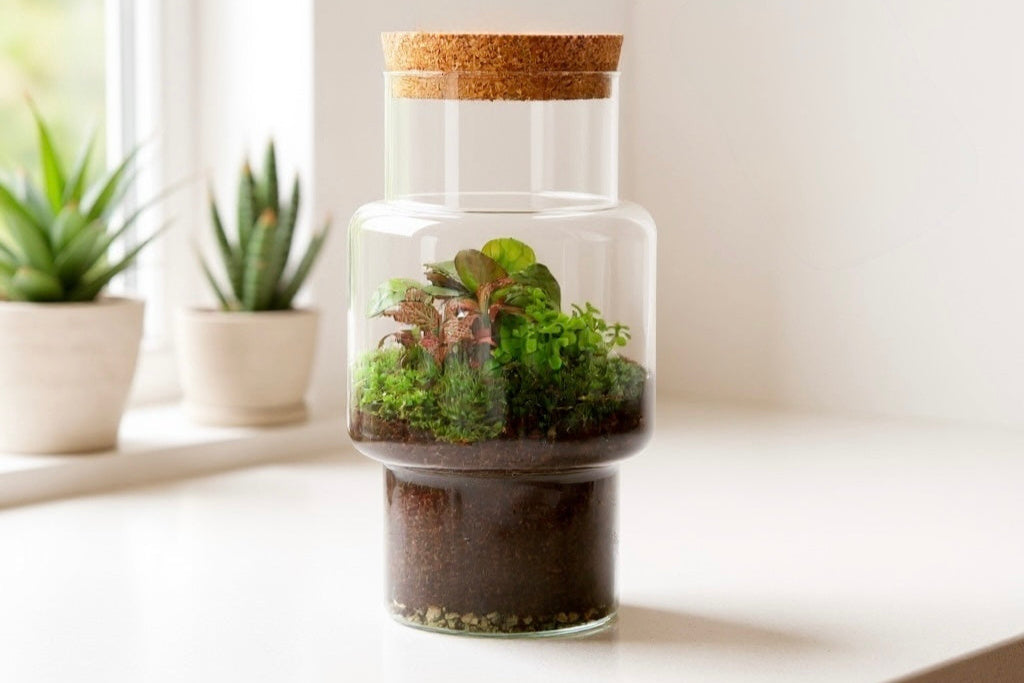
For those who want to keep things completely safe, there's a solution that poses no risk whatsoever: a closed terrarium. In a closed ecosystem, pets can't access the plants, soil, or any nutrients. The plants grow in a sealed environment and don't require any additional water or fertilizer.
That's why closed terrariums are ideal for homes with cats or dogs. They combine nature, ambiance, and safety in a single concept.
Practical tip to prevent accidents
Many pet owners worry about a cat or dog bumping into their terrarium. A simple way to prevent this is to use double-sided tape. By placing a small strip underneath the terrarium, the pot adheres lightly to the surface and won't shift if an animal bumps into it. It's a simple but effective way to protect both your terrarium and your interior.
Conclusion
Animal-friendly plants do exist, but you can only be completely certain when the grower is officially certified and can prove that the plant was grown without harmful substances. Plants that are naturally non-toxic remain a good choice, but the influence of pesticides, soil, and the individual sensitivities of animals makes the situation less clear-cut.
If you want to keep things absolutely safe, you can opt for a closed terrarium. This is not only beautiful to look at but also completely protected from curious pets. This way, you can still bring greenery into your home without any worries.
Deel: