

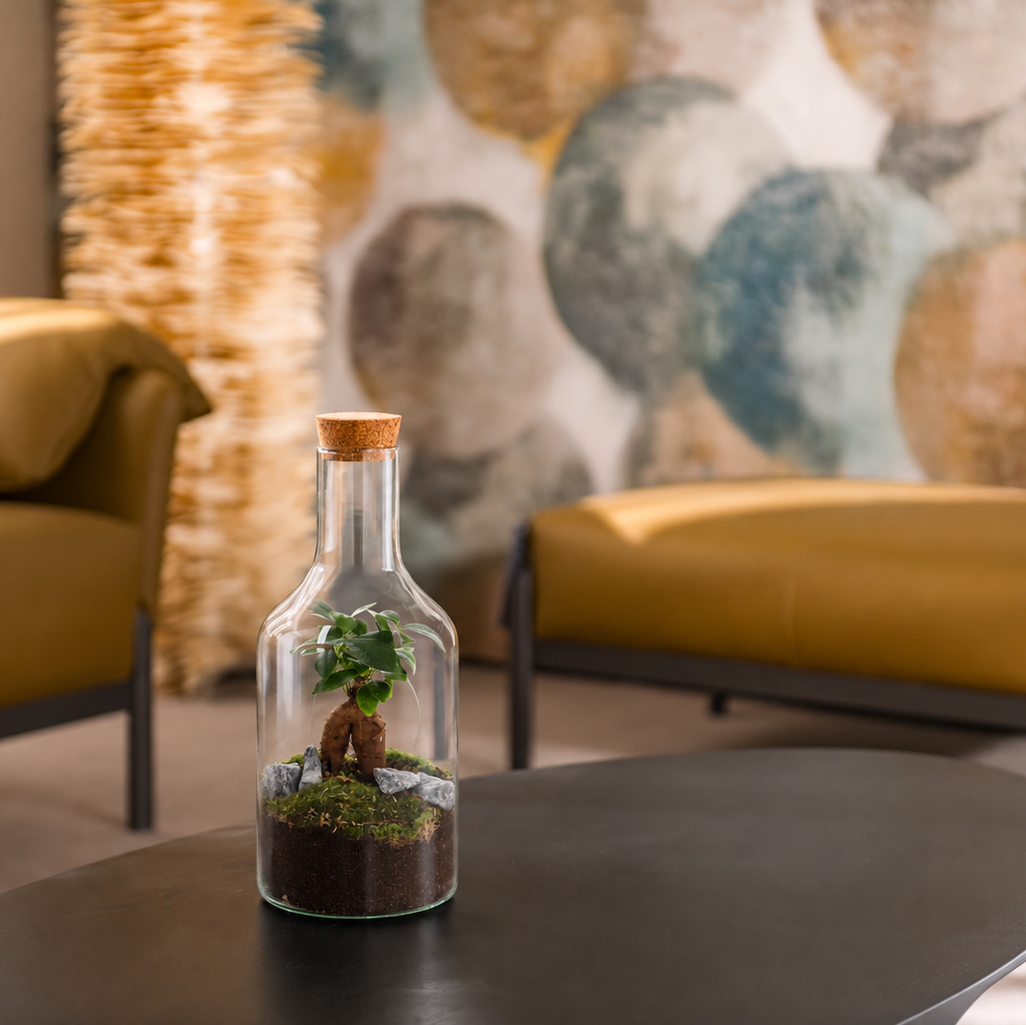
With its thick, gnarled "root-stem" and glossy green crown, the Ficus ginseng is one of the best-known bonsai trees in the Netherlands. It is strong, forgiving, and perfect for indoors, which is why for many people it is the first step into the world of bonsai. At The Green Bottle Garden, we place the Ficus ginseng in design pots, vases, and terrariums made of glass or ceramic. These do not have a hole in the bottom, which means that watering works a little differently than it does with a standard nursery pot. In this guide, you will read exactly what a Ficus ginseng is, what the difference is between a grafted and an ungrafted Ficus ginseng, and how to care for it in a pot without a drainage hole so that it remains beautiful for years to come.
What is a Ficus ginseng?
The Ficus ginseng is not a separate plant species, but a Ficus microcarpa (also known as the Chinese fig or Chinese banyan) that has been cultivated in a special way. The name "ginseng" comes from the striking, thickened base that is reminiscent of the ginseng root.
That thick part is not actually a trunk. Growers in Asia let the plant grow from seed, causing the part between the root and the stem to swell significantly. After a few years, the plant is lifted and replanted so that the thick tuberous root protrudes above the ground. This creates the typical Ficus ginseng bonsai appearance: a small tree on a sculptural pedestal.
Because the Ficus is a tropical tree, the Ficus ginseng is a true indoor bonsai. It loves warmth, light, and a constant environment.
Grafted and ungrafted Ficus ginseng: what is the difference?
If you are going to buy a Ficus ginseng bonsai, you will come across two variants. The difference lies in how the crown was formed.
An ungrafted Ficus ginseng has its branches growing directly from its own tuberous root. Everything you see is one plant. In shops and webshops, this variant is also often sold under the name Ficus ginseng retusa or Ficus retusa ginseng. These specimens often have slightly larger leaves and a more natural, sometimes wilder growth pattern. For example, our Bonsai Ficus in open Terrarium Bottle contains an ungrafted Ficus microcarpa 'Ginseng'.
A grafted Ficus ginseng has a crown from another Ficus variant that has been attached to the tuberous root. The grower makes an incision in the tuber and inserts a piece of branch (the scion) from a Ficus with more attractive characteristics, such as smaller leaves or more compact growth. Well-known grafted variants include Ficus microcarpa 'Green Island' and the 'Tiger Bark' with its striped bark.
This is how you recognize a grafted Ficus ginseng:
- You see thickenings or scars at the spot where the branches emerge from the tuber, sometimes still with remains of pruning wax.
- The bark or leaves of the branches differ visibly from those of the tuber.
- The leaves are often smaller and more compact than those of an ungrafted plant.
Neither is "better." A grafted Ficus ginseng looks well-groomed and compact right away, while an ungrafted plant has a more natural character and gives you more freedom when pruning.
Are there differences in care?
Basic care (light, water, temperature, and nutrients) is almost identical for both. There are, however, a few important differences, especially when it comes to pruning.
With a grafted Ficus ginseng, pay attention to the following. Sometimes new shoots grow directly from the tuberous root, below the graft site. These are shoots from the rootstock, and they are often stronger than the scion. If you leave them, they can eventually displace the grafted crown. Therefore, cut them away as soon as possible. Also, never prune below the graft site, or you will lose the graft. In addition, be careful when bending near the graft site, as that is the weakest part of the plant. Some grafted variants, such as the 'Tiger Bark', also require a little more light to maintain their color and compact growth.
With an ungrafted Ficus ginseng (retusa), you have more freedom. New shoots from the tuber are simply part of the plant and you can use them to form new branches. You can prune back more firmly, because the plant will sprout again on its own. This is useful, as it makes it easy to keep the crown in proportion with the pot or glass.
Caring for a Ficus ginseng in a pot without a drainage hole
Watering: the most important part
In a design pot, vase, or terrarium without a hole, excess water has nowhere to go. Whatever you give too much remains at the bottom. The roots then no longer get any air and will start to rot. Too much water is therefore the biggest cause of problems with a Ficus ginseng in a closed pot, much more often than too little water.
This is how to water correctly:
- Give a little at a time. Start with a small amount, for example a few tablespoons for a small pot, and pour gently around the plant. A watering can with a narrow spout makes this easy.
- Feel the soil first. Only water again when the top layer of soil feels dry. The soil may be slightly moist, but never wet or soggy.
- Lift the pot. A dry pot is noticeably lighter than a pot that has just had water. After a few times, you will feel exactly when it is time.
- Look through the glass. Is your Ficus in a glass terrarium or bottle? Then you can see immediately if there is water at the bottom. If you see a layer of water or the soil is dark and wet to the bottom, do not add any water.
- Less is better. Once every one to two weeks is often enough, but that depends on the temperature, the season, and the size of the pot. In winter, the plant clearly needs less. If in doubt? Then wait a few more days.
Did you give it too much water after all? Suck up the excess water with a pipette, a syringe, or a rolled-up piece of paper towel. With a pot, you can also hold the plant and soil with your hand and carefully tilt the pot so that the water runs out. Do not water for a while afterward.
Location and light
Place your Ficus ginseng in a light spot with plenty of indirect daylight, for example a few meters from an east- or west-facing window. Avoid bright, direct sunlight. Especially in glass, the air around the plant heats up quickly and the leaves can burn. Too little light leads to long, limp branches and leaf drop. Also keep the plant away from radiators or other heat sources.
Tip: turn the pot or terrarium a quarter turn occasionally. This way the bonsai grows evenly toward the light and the crown remains nicely round.
Temperature
Maintain a constant room temperature between 18 and 24 °C. Avoid drafts and sudden temperature changes, such as a spot near a frequently opened door or under the air conditioning.
Humidity
As a tropical plant, the Ficus loves humid air. Especially in winter, when the heating is on, you can occasionally lightly mist the leaves with a plant sprayer. Aim at the leaves and not the soil, so that no extra water gets into the pot. In a glass terrarium, the air around the plant naturally remains a bit more humid.
Nutrients
Because no water drains away, nutrient salts remain in the soil and can accumulate. Therefore, give only a little nutrition: in the spring and summer, half a dose of bonsai or houseplant food once a month, during a regular small watering. In the autumn and winter, do not provide any nutrients. It is not mandatory to provide nutrients; your Ficus bonsai can also grow well without them.
Keeping it compact instead of repotting
A Ficus ginseng in a design pot or terrarium does not need to be repotted every few years. Due to the limited space and regular pruning, it remains compact and can stay in the same pot for a long time. If the plant eventually becomes too large, you can move it to a larger pot. Always keep the tuberous root above the ground, as that is the characteristic part.
Pruning the Ficus ginseng
Pruning keeps your bonsai compact and ensures a fuller crown. The rule of thumb: let a branch produce six to eight new leaves and then prune it back to two leaves. The best time for major pruning is in the spring and early summer, but maintenance pruning can be done year-round. Also trim any outward-growing twigs in between so that the plant remains in proportion to the pot.
A white milky sap comes out of the wounds. That is normal. For larger pruning wounds, you can use wound paste. If you have a grafted Ficus ginseng, also remove the shoots that grow from the tuber below the graft site immediately.
Help, my Ficus ginseng is losing leaves!
Leaf drop is the most asked question about the Ficus ginseng bonsai, and there is usually a simple cause. The plant is sensitive to changes. A new spot, a move, or the transition to the heating season can already lead to the shedding of some of the leaves.
In a pot without a drainage hole, too much water is the main cause to check first. If the soil feels wet or there is water at the bottom, let the plant dry out well first. Other common causes are too little water (dry, curled leaves), too little light, drafts, or cold.
The advice: find a good, permanent spot and leave it there. Check the soil before watering. Usually, the plant will sprout again within a few weeks.
Is a Ficus ginseng poisonous?
The milky sap of the Ficus can irritate the skin and is slightly toxic to pets such as cats and dogs. If they eat the leaves, they may suffer from gastrointestinal complaints. Therefore, place the plant out of reach of curious pets and wash your hands after pruning.
Buying a Ficus ginseng bonsai: what should you look for?
Do you want to buy a Ficus ginseng bonsai? Then pay attention to these points:
- Grafted or ungrafted (retusa): choose grafted for a compact, immediately well-groomed tree, or ungrafted for a more natural character.
- Healthy tuberous root: the tuber should feel firm and dry, without soft or moldy spots.
- Leaves: choose a plant with glossy, firm leaves without yellow spots or sticky residue (a sign of pests).
- Pot or terrarium: a Ficus ginseng that is already ready-made in a design pot or terrarium is ready to be placed immediately and also makes an original gift.
At The Green Bottle Garden, you will find the bonsai Ficus ready-made in glass and design, such as the Bonsai Ficus in open Terrarium Bottle and the Bonsai Ficus in Lighting Black Duo with ambient lighting. Looking for a corporate gift? You can have the cork of the Terrarium Bottle engraved with a name or logo.
View all bonsai in our collection →
Frequently asked questions about the Ficus ginseng
Is a Ficus ginseng suitable for beginners?
Absolutely. It is one of the easiest and strongest bonsai trees there are. In a pot without a drainage hole, just make sure you don't overwater; it minds forgetting a watering session much less.
How often do I water a Ficus ginseng?
Not according to a fixed schedule, but as soon as the top layer of soil feels dry. In a pot without a hole, that is often once every one to two weeks, even less in winter. Always feel the soil with your finger first.
How much water does a Ficus ginseng in a pot without a hole need?
A little at a time. Start with a few tablespoons for a small pot and prefer to give a little more often than a lot at once. The water must never remain at the bottom, because it has nowhere to go.
What should I do if I have given too much water?
Suck up the excess water with a pipette, syringe, or piece of paper towel, or hold the plant and carefully tilt the pot so that the water runs out. Only water again when the soil is clearly drier.
How do I see if my Ficus ginseng is grafted?
Look at the place where the branches emerge from the tuber. If you see thickenings, scars, or a clear difference in bark there, it is likely grafted.
What is the difference between a Ficus ginseng retusa and a Ficus ginseng microcarpa?
Commercially, the name Ficus ginseng retusa is usually used for the ungrafted variant, where the branches and leaves grow from the tuberous root itself. The name microcarpa is used more broadly, and grafted specimens are often sold under the name of their grafted variant, such as 'Tiger Bark' or 'Green Island'. Botanically speaking, in both cases, it usually concerns Ficus microcarpa; the names are often used interchangeably in shops and webshops. The name does not matter for care: water, light, and nutrients are the same. The only difference is in pruning, as described above.
Why does my Ficus ginseng get yellow leaves?
In a pot without a drainage hole, that is usually a sign of too much water, sometimes of too little light. Check that the soil is not constantly wet and that there is no water at the bottom. A single yellow leaf at the bottom is normal; that is just old leaf making way for new.
Can a Ficus ginseng in a pot without a hole be outside?
We advise against it. Rainwater cannot drain away, so the pot will quickly be full of water and the roots will start to rot. Moreover, in glass, the plant heats up quickly in the sun. Therefore, keep your Ficus ginseng indoors all year round.
Should the cork stay on the Terrarium Bottle?
The cork is there for decoration. The Terrarium Bottle is an open terrarium with an opening at the back, so that the Ficus receives enough air.
How big does a Ficus ginseng grow?
That depends on how you prune it and which pot it is in. As a bonsai, you keep it compact through regular pruning, so that it remains nicely in proportion with its pot or terrarium.
Do I need to repot my Ficus ginseng?
In a design pot or terrarium, that is usually not necessary for a long time. It remains compact due to pruning and limited space. If it really becomes too big after a few years, move it to a larger pot in the spring and keep the tuber above the ground.
Can I take cuttings from a Ficus ginseng?
Yes, cuttings from a Ficus root quite easily in the spring or summer. Do keep in mind that a cutting does not get the thick, typical ginseng tuber. That only occurs in plants grown from seed. A cutting grows into a regular Ficus, which you can shape as a bonsai again.
What are the aerial roots on my Ficus ginseng?
With high humidity, such as in a glass terrarium, the Ficus sometimes produces thin roots that grow down from the branches. That is a sign that the plant is doing well. You can leave them hanging, trim them away, or lead them into the soil.
Does my Ficus ginseng suffer from pests?
A sticky leaf, white fluff, or small brown bumps on the branches indicate pests such as mealybugs, scale insects, or spider mites. This happens especially in dry air in the winter. Wipe the bugs away with a cloth and a mild soapy water, and mist the leaves occasionally.
Is a Ficus ginseng poisonous to cats?
Yes, slightly toxic. The milky sap can cause gastrointestinal complaints in cats and dogs if they gnaw on the leaf. Place the plant in a spot where your pet cannot reach it.
Bonsai Ficus > View the collection →
Deel:
Bought a Fusion Terrarium at the supermarket? Find out everything about its care here
Caring for Helleborus: tips for a healthy and profusely flowering Christmas rose