

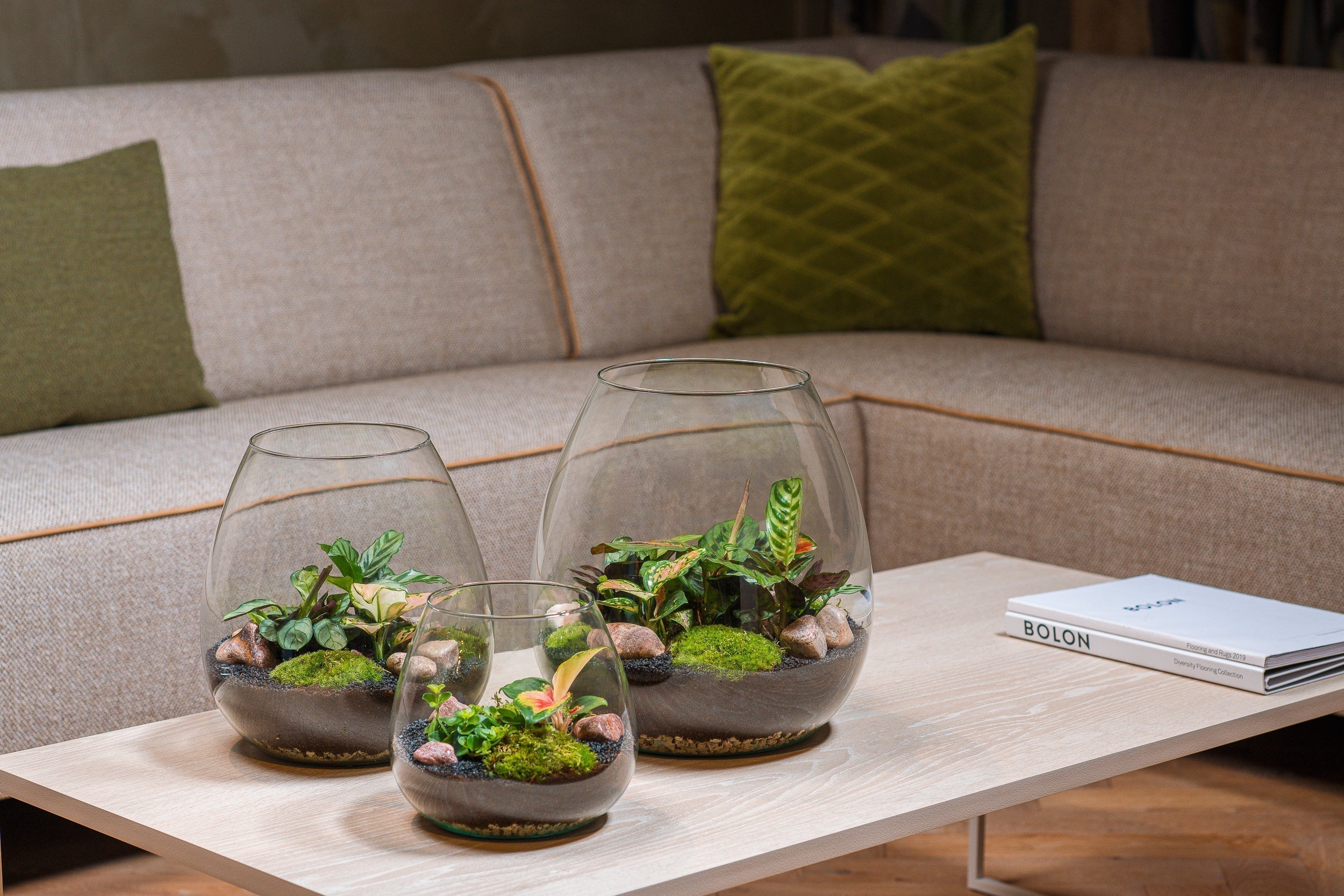
How to maintain a terrarium or ecosystem? – The complete guide to worry-free greenery in glass
A terrarium or closed ecosystem is not only a beautiful decorative piece, but also one of the easiest ways to bring greenery into your home. Nevertheless, every terrarium – whether open, closed or semi-terrarium – has its own form of maintenance. The good news: with a few simple guidelines, your terrarium will remain beautiful and healthy.
What is a terrarium?
The answer is quite simple. A terrarium is a glass vase or bottle with plants planted inside it. There are various terrariums: an open terrarium, a closed terrarium, or a semi-terrarium.
A closed terrarium is also called an ecosystem. It is sealed and self-sufficient in nutrients and water. You don't need to open it again.
An open terrarium is a terrarium where all kinds of plants can be placed. This one does require regular care.
A semi-terrarium is a terrarium that, with the right plants, can almost be treated like a closed terrarium, or if you leave it open, it's an open terrarium.

What is an ecosystem? (closed terrarium)
A closed terrarium or ecosystem functions as a miniature ecosystem. Just like in the real world: warm air rises, and in the terrarium, moisture evaporates. When warm air rises, clouds form on Earth. In the ecosystem, water collects on the glass, which we call condensation. From clouds comes rain. In the ecosystem, it drips back into the soil. There are advantages to this, but there can also be disadvantages. In most cases, it's just like on Earth: a mini-world, and thus a self-sufficient plant terrarium.
Advantage of an ecosystem: you no longer need to water it; place the cork on the terrarium on the specified date. it lets nature do its work.
Disadvantage of an ecosystem: you don't know what nature will do. In rare cases, plants might die. This can be resolved by adding a new plant to the terrarium. We call it, when a plant dies, compost. This strengthens the other plants with nutrients. You can see it as a disadvantage, but we see it as a strengthening of the other plants. As nature intended.
What to consider when caring for a closed terrarium/ecosystem?
Light
Place the terrarium in a bright spot, but not in direct sunlight. Too much sun causes overheating and burnt plants.
Water
A healthy ecosystem has sufficient moisture in the soil.
Do you see some condensation? Then it's perfectly balanced.
-
Too much condensation? Leave the terrarium open for a few hours.
-
No condensation and dry soil? Then a small splash of water is needed.
Pruning plants in your closed terrarium/ecosystem
Is a plant growing against the glass or becoming too enthusiastic? Then you can carefully prune it back. Don't do this too often; once every six months is more than enough.
Fungus formation in your closed terrarium/ecosystem
Sometimes a white film of mold can form in the soil of the terrarium. This is normal and harmless and is part of the natural ecosystem. In some cases, mold can also appear on the plants. This is not dangerous, but it usually indicates that there is too much moisture. Carefully remove any mold on the plants with tweezers or small scissors. Then let the terrarium air out temporarily so that excess moisture can evaporate and the ecosystem can rebalance. This helps to reduce mold formation.
Flies in your closed terrarium/ecosystem
Flies are often hidden in the soil or natural materials. When it gets warmer, the eggs hatch, and you see small flies around the terrarium. Fortunately, this is easy to solve.
Leave the glass open for a few hours so the top layer can dry. Then sprinkle a thin layer of sand over the soil; this prevents flies from laying new eggs. You can also use a small sticky trap for terrariums.
After a short time, the flies will disappear on their own, especially when the sand seals off the top layer and the terrarium can even air out.
Why an ecosystem?
If you choose an ecosystem, you are choosing nature and design. A real mini-jungle in your home. You see how the nature of the world works in your home or office.

What is an open terrarium?
An open terrarium offers a versatile choice of plants in glass. It is wonderful how beautiful and versatile an open terrarium is. You can create various terrariums with different plants, such as an orchid terrarium or a cactus terrarium. The versatility of real plants in glass does require some care: a little water and love. But still, maintenance remains simple.
Advantage of an open terrarium: the versatility of plant choice
Disadvantage of an open terrarium: requires a little care
What should you pay attention to when caring for your open terrarium?
Watering
-
Plants such as ferns and moss prefer slightly moist soil.
-
Cacti and succulents need little water.
Always check the soil before watering. Feel the soil with your fingers. If you have a bit more experience, you can tell by the color of the soil:
-
Gray-brown = no water
-
Brown = slightly moist
-
Dark brown = water
-
Very dark brown = too much water
Watering plants in an open terrarium
Succulents (cacti & succulents)
In summer, succulents usually need water once every 3 to 4 weeks. In winter, once every 6 to 7 weeks is often sufficient. Always allow the soil to dry out completely before watering again. Succulents store water in their leaves.
Green plants
Green plants usually need a small amount of water once every 1 to 2 weeks. The soil should be slightly moist, but never too wet. Therefore, it is better to give small amounts of water rather than too much at once.
Flowering plants
Flowering plants often need a little more water than green plants, especially during the flowering period. Keep the soil slightly moist, but prevent water from accumulating at the bottom of the pot. Regularly check if the top layer of soil feels dry before watering again.
Light in an open terrarium
Ensure sufficient daylight, but avoid direct sunlight – especially with glass bowls and vases, which can act as a powerful magnifying glass.
Pruning in an open terrarium
Plants can grow freely, but trim long or sprawling branches to maintain a beautifully shaped terrarium.
Algae or mold in your open terrarium
Sometimes a white film of what appears to be mold forms in the soil. This is normal and harmless. Carefully remove mold with tweezers and even air out the terrarium.
Flies in an open terrarium
Same as above: leave the glass open, scatter a thin layer of sand underground, use a sticky trap, and the flies will disappear on their own.
Why an open terrarium?
Are you going for the versatility of an open terrarium? You can enjoy your open terrarium for a long time. With a little care, you can functionally enjoy beautiful design. Whether you go for an orchid, which blooms and then lets you enjoy the green plants around it, or a cactus terrarium, these require little care, and so you enjoy beautiful design in glass.

What is a semi-terrarium?
A semi-terrarium cannot be maintained exactly like a closed terrarium because you will need to water it after a few months or sometimes a year. And it's not quite an open terrarium, precisely because you need to water it less often if you keep it closed frequently. A semi-terrarium can be planted with all types of plants; with green plants, you can often keep it closed for months, even up to a year, without watering. This is because it functions as a closed ecosystem. If you have succulents or flowering plants in your semi-terrarium, you will need to open it occasionally to prevent root rot.
Maintenance tips for green plants in a semi-terrarium
Green plants in a semi-terrarium require little maintenance, as long as there is a good balance between light, water, and air. For green plants such as Fittonia, Calathea, ferns, Pilea, or moss, you can treat a semi-terrarium almost the same as a closed terrarium. Keep the semi-terrarium closed as much as possible, as this creates a stable microclimate. In that case, you usually only need to water it once every three to four months. Feel the soil or the moss; if it's moist, you don't need to water it. If it feels dry, add a small amount of water. If you see a lot of condensation on all sides of the glass for two consecutive days after watering, open the terrarium for one or two days so that excess moisture can evaporate. This prevents the soil from remaining too wet and helps prevent root rot in the plants.
Maintenance tips for succulents in a semi-terrarium
Succulents in a semi-terrarium require different care than green plants, as they are naturally accustomed to drier conditions. It is important not to keep the semi-terrarium completely sealed. Regularly leave the glass open so that moisture can escape and the air remains dry. A semi-terrarium with succulents can even remain permanently open. Water succulents sparingly. In most cases, a small amount of water once every four to five weeks is sufficient, depending on the temperature, location, and the type of semi-terrarium. A completely sealed semi-terrarium requires less water than a semi-terrarium that can be opened. Always check the soil first; it should feel completely dry before you water again. Too much water remains in a glass terrarium longer and increases the risk of root rot.
Maintenance tips for flowering plants in a semi-terrarium
Flowering plants in a semi-terrarium require a bit more attention than green or succulent plants, as they need energy to develop and maintain flowers. It is important to place the terrarium in a bright spot, but not in direct sunlight, so that the flowers do not burn. Monitor the humidity: a semi-terrarium can remain partially closed, but open it at least three times a week, ensuring that fresh air can circulate occasionally to prevent mold growth. Water sparingly and adjust to the plants' moisture needs. Regularly check the soil; if it feels dry, add a small amount of water. Too much water can cause root rot, while too little water will make the flowers wilt. Remove withered flowers and leaves immediately so that the plant can focus its energy on new blooms.
General tips for every terrarium
• Touch the inside of the glass as little as possible – fingerprints remain visible for a long time.
• Use rainwater or cooled, lightly boiled water to prevent limescale stains.
• Do not place the terrarium near heating – this causes it to dry out faster.
Maintaining a terrarium? Child's play.
Whether you have an open terrarium, a self-sustaining ecosystem, or a semi-terrarium: the care is surprisingly simple. A little light, occasional ventilation, a splash of water, and most importantly... let it be.
With minimal attention, you can independently enjoy a living work of art in glass.
View Collection:

Share:
Mini Christmas tree care: Ellwoodi & Toppoint indoors and outdoors
How do you care for a cactus? And is it really that simple?