

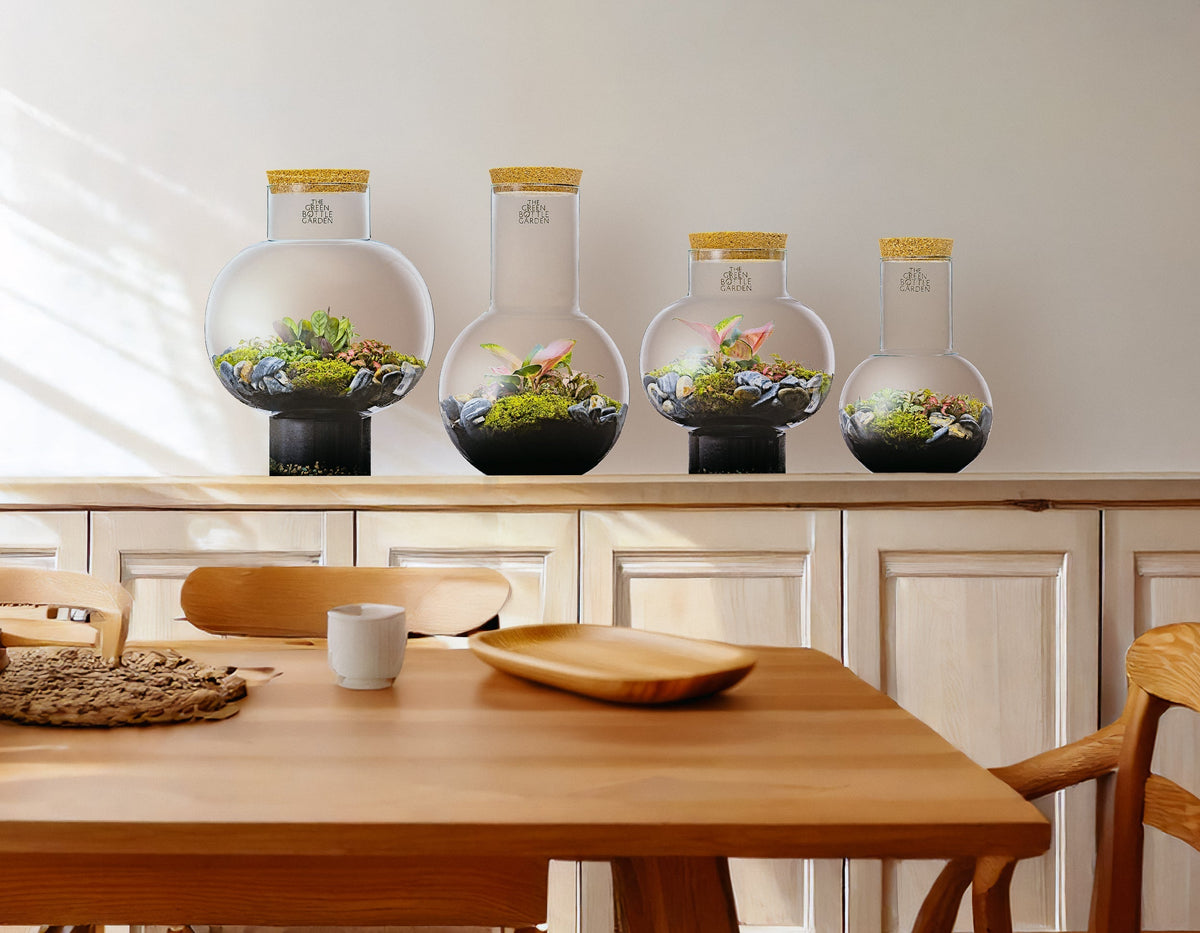
Are your plants drooping? Are they turning yellow, getting mold, or even dying? Don't panic. A closed terrarium is a living ecosystem. Just like in nature, the balance can sometimes be temporarily disturbed. Most problems are easy to solve.
In this guide, you'll discover the 10 most common reasons why a terrarium deteriorates, and what you can concretely do about them.
1. Too much condensation on the glass
A little condensation is normal and shows that the water cycle is working. However, if you see thick droplets all day long on the glass, then the ecosystem contains too much moisture.
Solution: Remove the cork or lid for a few hours and let excess moisture evaporate. In a healthy terrarium, you usually only see light condensation in the morning or evening.
2. No condensation and dry soil
Weeks with no condensation and a light brown soil? Then your terrarium has probably become too dry.
Solution: Add a small amount of rainwater or low-calcium water along the glass. Never add large amounts directly — too much water will cause new problems.
3. Direct sunlight
This is by far the most common mistake made with terrariums. A closed terrarium acts like a small greenhouse: when it stands in direct sunlight for an extended period, the temperature can quickly rise, causing plants to burn or die.
Generally, some direct sunlight in the morning or evening is not harmful. Avoid the bright midday sun, as this can heat up the terrarium the fastest.
Solution:
Place your terrarium in a bright spot, but avoid direct sunlight during the hottest hours of the day. Also, do not place the terrarium next to a radiator or other heat source.
4. Mold on plants or moss
A white haze in the soil is often harmless and part of the natural decomposition processes within an ecosystem. Mold on leaves or moss usually indicates an disturbed balance in the terrarium. This is often caused by too much moisture, but in some cases, it can also arise when plants or moss become weakened by dehydration.
Unfortunately, mold cannot always be completely removed. However, there are several measures that can help prevent further spread and increase the chances of the ecosystem recovering.
Solution:
- Carefully remove affected leaves or parts of the moss.
- Temporarily air out the terrarium so that excess moisture can escape.
- Check the amount of condensation and adjust the moisture balance if necessary.
A healthy ecosystem often finds its natural balance again. If the mold keeps returning, it may indicate that the moisture balance is not optimal and the terrarium is structurally too humid or too dry. Therefore, regularly check the condition of the plants, the moss, and the condensation on the glass.
5. Flies in the terrarium
Small flies can come from eggs that were already in the soil. In warm weather, they become extra active.
Solution: Leave the terrarium open for a few hours, sprinkle a thin layer of sand over the soil, or use a small sticky trap. Over time, the flies will disappear on their own.
6. Yellow leaves
Yellow leaves can be caused by too much moisture, too little light, or the natural dying off of old leaves.
Solution: Check the moisture balance and the location. Then remove the yellow leaves so the plant can put energy into new growth.
7. Brown leaves
Brown leaves usually indicate dehydration or overheating — often because the terrarium is too close to a south-facing window.
Solution: Move the terrarium to a bright spot without direct sunlight and check if the soil still contains enough moisture.
8. Plants growing against the glass
In a healthy ecosystem, plants sometimes grow faster than expected. Leaves then press against the glass, which means less light enters the terrarium.
Solution: Prune the plants carefully. In a closed ecosystem, pruning once or twice a year is usually sufficient.
9. A plant dies
Don't immediately panic if one plant doesn't make it. In a natural ecosystem, dead plants are broken down by microorganisms, releasing nutrients for the other plants.
Solution: Remove the plant if it no longer looks good — or let nature take its course. Often, the other plants continue to grow healthily.
10. The ecosystem needs time
Many people expect a terrarium to function perfectly immediately. In reality, an ecosystem needs time to find a natural balance. Temporarily a lot of condensation, a little mold, or a plant that becomes less attractive — that doesn't mean the ecosystem has failed. Often, it recovers on its own.
When should you be concerned?
Only take action if you see the following for an extended period:
- All plants are drooping
- There is constantly an extreme amount of condensation
- Multiple plants are dying simultaneously
In most cases, a small adjustment of light or moisture is enough to bring the ecosystem back into balance.
A healthy terrarium lasts for years
A well-arranged closed terrarium is a self-sufficient ecosystem where water, plants, and microorganisms work together in a natural cycle. With the right amount of light and moisture, such an ecosystem can remain beautiful for years — without you having to water it regularly.
Are you looking for a low-maintenance ecosystem? Then check out the handmade ecosystems from The Green Bottle Garden, such as the Ecosysteem Olaf or the Ecosystem Laura — delivered ready-made and designed as self-sufficient mini-ecosystems.
view all Ecosystems
Deel:
Sempervivum (Houseleek) Care – Complete Growing Guide
Bought a Fusion Terrarium at the supermarket? Find out everything about its care here