

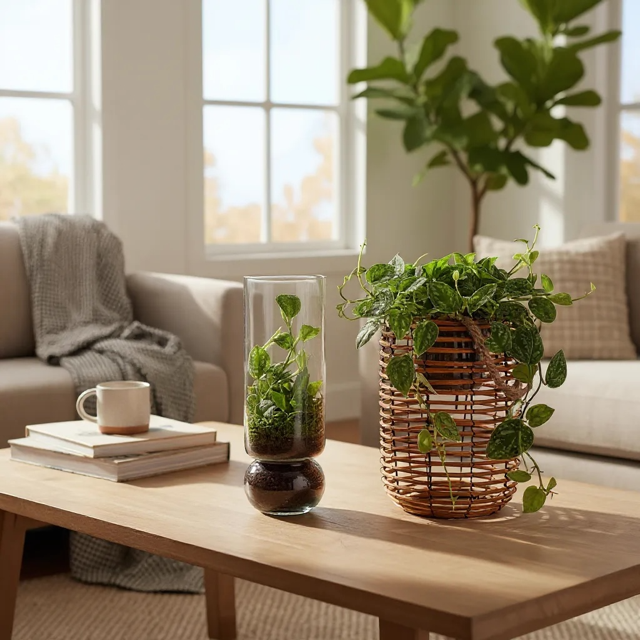
Scindapsus Pictus care: all you need to know
The Scindapsus pictus, also known as the Satin Pothos or Silver Pothos, is one of the most popular houseplants of the moment. Thanks to its dark green leaves with silvery markings, this tropical plant is a real eye-catcher in any interior.
Originally, the Scindapsus pictus grows in the tropical rainforests of Southeast Asia, where it climbs trees using aerial roots. Indoors, you can use the plant both as a hanging plant or let it climb along a moss pole or plant support.
Because the Scindapsus is low-maintenance, it is an excellent choice for both beginner and experienced plant lovers.

Scindapsus care
Light
The Scindapsus pictus likes bright, indirect light. This helps the silver markings on the leaves stay their most vibrant.
The plant can also thrive in a spot with less light. However, keep in mind that:
- growth will be slower;
- new leaves may remain smaller;
- the silver leaf markings will be less prominent.
Avoid prolonged direct sunlight, especially in summer. This can cause leaf scorch.
Watering
The Scindapsus prefers slightly moist potting soil, but it's better to be a little too dry than too wet.
Therefore, always check the top 2 to 3 centimeters of the potting soil first.
- Is the soil dry? Water it.
- Does the soil still feel moist? Wait a few more days.
On average, this means:
- Spring and summer: approximately once a week.
- Autumn and winter: once every 10 to 14 days.
The exact amount of water depends on the temperature, humidity, and pot size.
Prevent the roots from sitting in water for too long. This can cause root rot.
Humidity
As the Scindapsus originates from the rainforest, it thrives in higher humidity.
Normal indoor humidity is usually sufficient. During dry winter months, occasional misting or a humidifier can help keep the leaves looking beautiful.
Temperature
The ideal temperature is between 18°C and 27°C.
Avoid:
- cold drafts;
- temperatures below 15°C;
- sudden temperature fluctuations.
Feeding
During the growing season (March to September), you can fertilize the plant once a month with green houseplant food.
In autumn and winter, the plant hardly grows, and extra feeding is not necessary.
Pruning
If the vines become very long or bare, you can easily prune the Scindapsus.
New shoots usually emerge just below the pruning site, making the plant fuller.
The cuttings can also be easily rooted in water or potting soil.
Is Scindapsus toxic?
Yes. The Scindapsus pictus is mildly toxic to cats, dogs, and humans if parts of the plant are eaten. Therefore, place the plant out of reach of curious pets and small children.
Common problems
Yellow leaves
This is usually caused by too much water.
Brown leaf tips
Often a result of dry air or irregular watering.
Limp leaves
The plant is usually thirsty. Water it, and the leaves often recover within a few hours.
Little silver marking
The plant probably isn't getting enough light. Move it to a brighter spot without direct sunlight.
Different types of Scindapsus pictus
There are several beautiful varieties of Scindapsus pictus.
Scindapsus pictus 'Argyraeus'
The best-known variety with smaller leaves and fine silver speckles. We use this variety at The Green Bottle Garden due to its elegant appearance and compact growth.
Scindapsus pictus 'Silvery Ann'
Has larger silver areas, making the leaves appear almost entirely silver.
Scindapsus pictus 'Trebie'
A larger variety with broad leaves and striking silver-green patterns.
Scindapsus pictus 'Exotica'
Has extra large leaves with many silver-colored areas and grows more vigorously than most other varieties.
Scindapsus in bottles, vases, and terrariums
At The Green Bottle Garden, we incorporate the Scindapsus pictus 'Argyraeus' into various handmade glass and ceramic designs.
Thanks to its graceful vines and gentle growth, this plant is particularly suitable for stylish home decor.
One of our most popular creations is the Scindapsus in Lantern. Here, the plant is combined with atmospheric lighting, creating a warm and natural look. This makes the lantern not only a beautiful addition to your interior but also an original housewarming gift, birthday gift, or sustainable plant gift.
Deel:
Amaryllis Bulb Without Water: Tips for a Flowering Plant Without Too Much Care | the perfect plant gift
Everything You Need to Know About Plants: Care, Home Decor and Gift Ideas